





More than 700 people were caught inside one of Los Angeles’ largest recent street takeover enforcement operations, resulting in 69 arrests, 570 citations and 200 vehicles being impounded as city leaders promise this is just the start.
For years, the scene has become increasingly familiar across parts of Los Angeles.
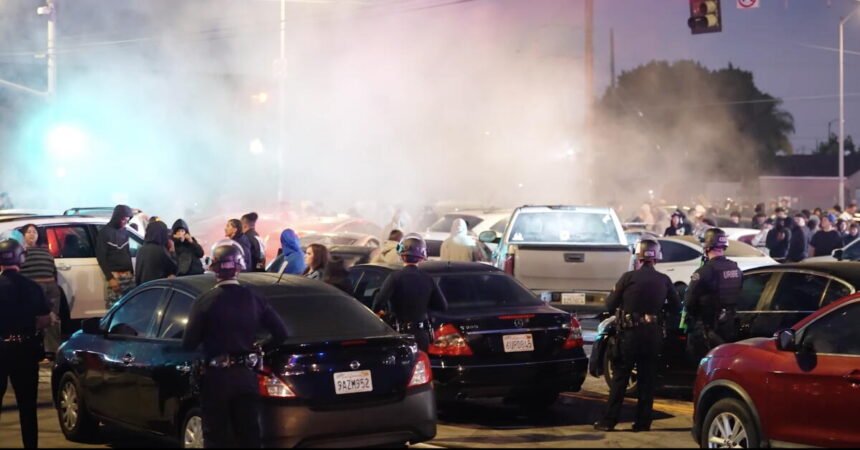
An intersection suddenly fills with cars. Engines roar. Tires spin through clouds of smoke as hundreds of spectators surround the roadway, phones raised to capture the spectacle. Within minutes, an ordinary neighborhood intersection can become an unofficial arena.
Early Saturday morning, Los Angeles police decided not to simply break up the crowd.
They surrounded it.
At approximately 3:20 a.m. on September 5, more than 700 people had gathered around South Figueroa Street and West Alondra Boulevard in Harbor Gateway for an illegal street takeover. What participants may not have realized was that law enforcement had been watching the activity develop throughout the night.
The operation, appropriately named Operation Street Sweeper, involved more than 150 Los Angeles Police Department officers along with personnel from the California Highway Patrol and Los Angeles County Sheriff’s Department.
Using drones and other intelligence, authorities tracked several takeovers as they developed before officers moved into position around the Harbor Gateway gathering. Instead of arriving with lights and sirens and giving participants an opportunity to scatter, officers approached from multiple directions and effectively boxed the crowd inside the area.
What followed was one of the most significant street takeover crackdowns Los Angeles has seen in recent memory.
By the time the operation was complete, police reported 69 arrests and 570 citations. Of those citations, 442 were issued to people accused of spectating at a speed contest. Another 128 citations involved juveniles between the ages of 11 and 17 for curfew violations.
Police also impounded 200 vehicles and recovered seven firearms along with canisters of nitrous oxide.
Three of the arrests involved allegations of assaulting a police officer, battery and interfering with officers. The remaining 66 arrests were connected to alleged participation in or assistance with the street race or takeover.
For LAPD Chief Jim McDonnell, the size of the operation was intended to send a message far beyond one intersection.
“This is only the beginning,” McDonnell said following the crackdown.
And Los Angeles officials appear determined to make that message clear.
Street takeovers have become more than a traffic problem for neighborhoods across Southern California. Residents living near frequently targeted intersections have described being awakened by engines, screeching tires and crowds arriving in the middle of the night. The events can place drivers, spectators, pedestrians and nearby residents at risk while leaving communities to deal with damaged roads, debris and disruption after the crowds disappear.
At Figueroa and Alondra, residents told local media that takeover activity had become predictable enough that they knew when to expect it.
This time, law enforcement was waiting too.
Video captured during the operation showed some attendees attempting to escape as officers moved in. People were seen running through yards and climbing fences while some drivers trying to leave reportedly crashed into other vehicles.
Perhaps one of the most striking numbers to emerge from the operation was not the number of cars or citations, but the age of some of those attending.
Authorities said 128 minors received curfew citations, with juveniles at street takeover events ranging as young as 11 years old.
McDonnell used the moment to directly address parents, urging them to know where their children are and warning that a single decision at one of these gatherings can have consequences far beyond a citation.
“This is not harmless fun. This is criminal behavior,” he said.
The vehicles involved also tell a complicated story.
According to authorities, cars appearing at takeovers are not always owned by the people driving them. Police say these events can involve stolen vehicles, rentals and cars borrowed from family members who may have no idea where their vehicle has gone. Investigators were still processing the 200 vehicles impounded during the Harbor Gateway operation.
Los Angeles Mayor Karen Bass also backed the crackdown, saying the city has zero tolerance for illegal street racing and takeovers and promising continued prevention, enforcement and deterrence efforts.
The operation could represent a change in how Los Angeles approaches a problem that has often been difficult for police to contain.
Street takeovers can be organized rapidly through social media. Locations can change without warning, and crowds can disperse quickly once law enforcement is spotted. Police officials say a takeover can move from online planning to a packed intersection in a matter of minutes.
Operation Street Sweeper turned that speed against the participants.
Rather than chasing scattered cars through Los Angeles after the gathering broke apart, officers allowed the crowd to assemble, surrounded the intersection and then began processing participants, spectators and vehicles.
It was a massive undertaking, particularly for a police department that continues to face staffing challenges. McDonnell acknowledged that operations involving more than 150 officers cannot necessarily happen at every gathering, but said similar task forces will be assembled when circumstances warrant them.
City officials are also looking beyond individual enforcement operations. McDonnell has expressed support for stronger measures that could allow authorities to permanently seize and potentially destroy vehicles used in illegal takeovers, although such a policy would require further action from city leaders.
For the families living around Figueroa and Alondra, however, the larger policy debate may be less important than something much simpler.
A quiet intersection.
For one morning, the tire smoke cleared, the engines went silent and hundreds of vehicles left the neighborhood on tow trucks instead of racing away.
Los Angeles officials say the crackdown was not designed as a single dramatic show of force.
It was designed as a warning.
And if the city follows through on that promise, Operation Street Sweeper may mark the beginning of a much more aggressive chapter in Los Angeles’ fight against illegal street takeovers.